Losing an adult tooth can feel overwhelming, whether it happens due to a sudden injury, severe decay, or an unavoidable extraction. If the gap is hidden in the back of your mouth, you might be tempted to just leave it alone. Many patients in Plainfield, Joliet, Naperville, and the surrounding Chicago suburbs do exactly this to save time or money.
However, ignoring that empty space is rarely a safe long-term strategy for your oral health. Your mouth is a highly complex system, and removing even one piece permanently disrupts its natural balance. If you are wondering what happens if I don’t replace a missing tooth, the answer involves structural changes to your bone, your bite, and your wallet.
Why a Missing Tooth is More Than a Cosmetic Issue
When you lose a visible front tooth, the rush to find a missing tooth replacement is usually immediate. We rely heavily on our front teeth to speak clearly, smile with confidence, and interact socially. But when a molar is lost out of sight, that sense of urgency often fades away entirely.
This is a dangerous misconception because every single tooth plays a vital, functional role in chewing and supporting its neighbors. Without a complete set of teeth, you are unconsciously forced to alter how you chew your food. This places unnatural, heavy stress on your remaining teeth, leading to premature enamel wear and microscopic fractures.
What seems like a harmless gap actually forces your remaining teeth to work overtime every time you eat. Over time, this functional overload can weaken healthy teeth and lead to further tooth loss.
The Silent Danger: Jawbone Loss and Facial Aging
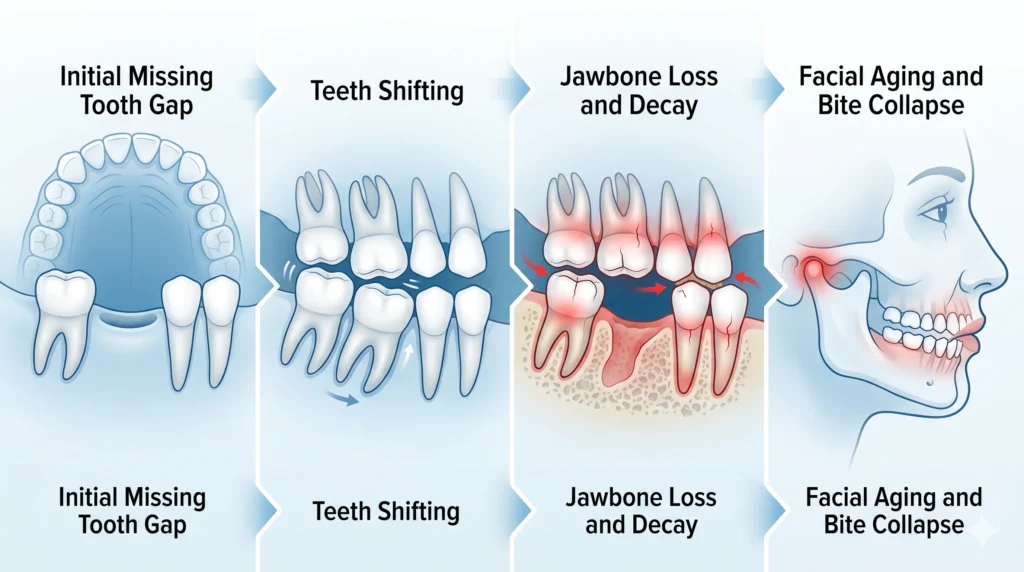
The most severe consequence of a missing tooth happens entirely out of sight, deep beneath your gum line. Your jawbone relies on the constant, daily pressure of chewing to stay strong and dense. When a tooth is removed, that vital stimulation disappears instantly from that specific area.
Without this pressure, the body assumes the bone is no longer needed and begins to reabsorb it. This rapid deterioration is known as jawbone loss, and it can begin within just six months of an extraction. As the bone physically shrinks, you might notice signs of jawbone resorption, such as a changing facial profile or a sunken appearance around your mouth.
This bone loss does not just weaken your jaw; it prematurely ages your face. By the time these physical changes become visible in the mirror, the structural damage beneath the surface is already quite advanced.
How Shifting Teeth Can Ruin Your Entire Bite
Teeth are remarkably active; they constantly seek contact with one another to maintain their alignment. When an empty space appears, the neighboring teeth will slowly tilt and drift into the newly available gap. This process, known as tooth shifting, fundamentally alters the alignment of your entire smile.
As your teeth drift out of their proper positions, your upper and lower jaws no longer meet correctly when you close your mouth. This misalignment creates a poor bite, which frequently leads to chronic jaw pain, headaches, and TMJ disorders. Furthermore, shifted teeth create tight, awkward spaces that are incredibly difficult to clean with a toothbrush or floss.
This inability to clean properly makes the remaining teeth highly susceptible to severe plaque buildup and gum disease. A single missing tooth can quickly trigger a domino effect of decay and inflammation throughout your mouth.
How to Protect the Gap and Your Oral Health Until Your Visit
If you have recently lost a tooth or had one extracted, it is crucial to protect the area while you plan your next steps. Leaving the healing socket vulnerable can invite dangerous bacteria and slow down the recovery process. Until you can see your dentist for a permanent solution, you must manage the space carefully.
Here are a few actionable ways to protect your oral health right now:
- Keep the area pristine: Gently rinse your mouth with warm salt water two to three times a day to naturally kill bacteria and reduce inflammation.
- Brush with extreme care: Continue brushing your other teeth twice a day, but use very gentle, sweeping motions when navigating near the empty socket.
- Chew on the opposite side: Avoid biting down on hard, crunchy, or sticky foods near the gap to prevent painful trauma to the exposed gums.
- Watch for warning signs: If you notice severe swelling, throbbing pain, or a foul taste in your mouth, contact your dentist immediately, as these are signs of infection.
These steps will help maintain a healthy environment, but they are only a temporary bridge. You still need a professional evaluation to prevent the long-term, irreversible damage associated with bone loss.
Implants vs. Doing Nothing: A Financial Comparison Over Time
It is completely normal to hesitate when researching the dental implant cost Plainfield IL clinics require for restorative treatment. The upfront investment for a high-quality implant can seem intimidating when compared to simply doing nothing. However, doing nothing is rarely free in the long run.
When you leave a gap untreated, the resulting bone deterioration and shifting teeth eventually demand complex, expensive treatments. You may end up needing costly bone grafting surgeries just to restore the jaw, or extensive orthodontic work to fix your ruined bite. Additionally, the rapid decay that forms around shifted teeth often requires expensive crowns or root canals.
An implant is the only restoration that mimics a natural root, preserving your bone and locking your surrounding teeth safely in place. It is a one-time investment that actively protects your smile from a lifetime of costly, compounding dental emergencies.
Full-Arch Solutions in Plainfield: Restoring Your Quality of Life
Whether you are missing a single molar or require full-arch solutions to replace a complete set of teeth, modern dentistry offers incredible relief. Getting dental implants Plainfield residents trust means investing in a permanent, natural-looking smile that functions exactly like your real teeth. You do not have to live with the daily discomfort of a shifting bite or the hidden dangers of bone loss.
Our dedicated team proudly serves the communities of Plainfield, Joliet, Naperville, and the surrounding Chicago suburbs. We use state-of-the-art technology to ensure your implant procedure is precise, comfortable, and tailored entirely to your unique needs. Do not wait for irreversible bone damage to dictate your health and happiness.
Don’t let a missing tooth change your face or your budget. Call our Plainfield office today to schedule your implant consultation.
Book your visit today: https://dentalplainfield.com/contact-us/
Learn more: https://dentalplainfield.com/