
Meta Title: Affordable Dental Implants Near Chicago | Plainfield, IL
Meta Description: Explore dental implant options, cost factors, treatment alternatives, and how to choose an implant dentist in Plainfield, IL, near Chicago.
Affordable Dental Implants Near Chicago: Options, Cost Factors, and Choosing a Dentist in Plainfield, IL
Missing teeth can affect more than the appearance of your smile. A gap may change how you chew, influence speech, place additional pressure on nearby teeth, and affect how confident you feel in photographs or social situations. Over time, an untreated space may also contribute to changes in the surrounding bone and the way your teeth fit together.
For patients searching for affordable dental implants near me, the goal should not simply be to find the lowest advertised fee. The better goal is to find a clinically appropriate treatment plan that is clearly explained, carefully planned, and designed to provide dependable long-term value.
Patients in Plainfield, Illinois, and the surrounding Chicago suburbs can often receive modern implant care without the traffic, parking challenges, or scheduling difficulties associated with traveling downtown.
This guide explains how dental implants work, what affects the overall treatment cost, which tooth-replacement options may be available, and how to evaluate an implant dentist near Chicago.
What Is a Dental Implant?
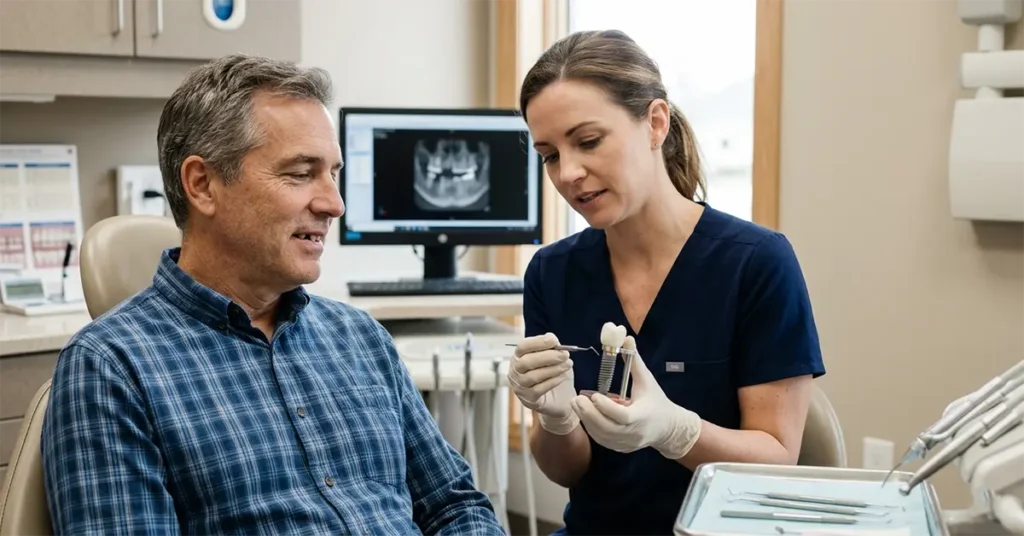
A dental implant is a small post placed in the jawbone to replace the root of a missing tooth. Once the area has healed, the implant can support a custom crown, bridge, or full-arch restoration.
A complete dental implant treatment may include:
-
The implant post placed in the jawbone
-
An abutment connecting the implant to the restoration
-
A custom crown, bridge, or implant-supported denture
-
Diagnostic imaging and digital treatment planning
-
Follow-up visits during the healing process
Every patient has different bone levels, gum health, medical history, and restorative needs. For that reason, an accurate implant plan can only be created after a professional examination and appropriate imaging.
How Much Do Dental Implants Cost in Illinois?
There is no single cost that applies to every dental implant case. The overall investment depends on the number and location of missing teeth, the condition of the bone and gums, the type of restoration selected, the materials used, and whether any preparatory procedures are required.
A single-tooth implant generally involves an implant post, an abutment, and a custom crown. Several neighboring teeth may sometimes be replaced with an implant-supported bridge. Patients missing most or all teeth in an arch may be evaluated for an implant-supported denture or a fixed full-arch restoration.
When comparing implant estimates, request a written breakdown of everything included in the treatment plan.
Some estimates may cover only the surgical placement of the implant. Others may also include diagnostic imaging, the final restoration, follow-up appointments, and related procedures.
Comparing complete treatment plans is more useful than comparing one advertised figure.
What Factors Affect Dental Implant Costs?
Several clinical and restorative factors can influence the final treatment plan.
Bone Support and Grafting
Dental implants require adequate bone support. When a tooth has been missing for an extended period, the surrounding bone may change or decrease.
Some patients may require bone grafting or another preparatory procedure before the implant can be placed securely.
Number and Location of Missing Teeth
Replacing one front tooth is different from restoring several back teeth or an entire arch.
The number, position, and spacing of the missing teeth affect the number of implants required and the design of the final restoration.
Type of Restoration
A single implant crown, implant-supported bridge, removable implant denture, and fixed full-arch restoration are different treatments.
Each option requires a different level of planning, laboratory work, materials, and follow-up care.
Materials and Laboratory Design
The implant system, abutment design, crown material, and laboratory process may affect the appearance, strength, and future maintenance of the restoration.
Your dentist should explain which materials are being recommended and why they are appropriate for your case.
Imaging and Digital Planning
Three-dimensional CBCT imaging and digital scanning can help the dentist evaluate the available bone, surrounding structures, implant position, and space for the final tooth.
These technologies may also make it easier for patients to understand the proposed treatment plan.
Treatment Complexity
Existing infection, gum disease, bite forces, tooth removal, healing requirements, and the possibility of immediate or staged implant placement can all affect the sequence and complexity of care.
Dental Implant, Bridge, or Denture: Which Option Is Right for You?
The most affordable solution is not always the treatment with the lowest initial cost.
The right option should balance oral health, function, appearance, maintenance requirements, and long-term value.
Single-Tooth Dental Implant
A single implant can replace one missing tooth without depending on neighboring teeth for support.
It may be appropriate for patients with adequate bone and healthy surrounding tissues. Many patients choose this option because it can provide independent support for the replacement tooth and a natural-looking result.
Traditional Dental Bridge
A traditional bridge replaces a missing tooth by using the neighboring teeth as supports.
It may be a practical option when those teeth already require crowns or when implant treatment is not recommended. Patients should understand how the supporting teeth will be prepared and how the area beneath the bridge must be cleaned.
Removable Denture
A partial or complete denture can replace multiple missing teeth and may be an appropriate starting point for some patients.
Dentures require routine maintenance and may need adjustments as the mouth changes over time.
Implant-Supported Denture
Implant-supported dentures may provide greater stability for suitable patients. They can be considered as an immediate treatment option or as a future upgrade from a traditional denture.
A clinical evaluation is required to determine the appropriate number and position of implants.
Are Dental Implants Worth It?
Dental implants can provide meaningful long-term value for patients who want improved chewing comfort, a secure replacement option, and a restoration designed to function naturally.
In certain cases, implants also avoid using neighboring teeth to support the replacement.
However, dental implants are not automatically the right choice for every patient. Gum health, bone support, medical conditions, smoking, oral hygiene, and personal treatment goals all matter.
A professional consultation should explain:
-
The potential benefits of treatment
-
Possible limitations or risks
-
Alternative tooth-replacement options
-
The expected treatment timeline
-
Healing and maintenance responsibilities
The final recommendation should be based on your clinical condition rather than a general online estimate.
How Long Do Dental Implants Last?
Dental implants are designed as a long-term tooth-replacement option, but their lifespan depends on treatment planning, healing, daily oral hygiene, professional maintenance, bite forces, and general health.
The implant placed in the jawbone and the visible restoration above it are separate components.
The implant may remain stable for many years, while the crown, bridge, or denture may eventually require maintenance, repair, or replacement because of normal wear.
Regular dental visits allow the dentist to monitor the implant, surrounding gum tissue, bite, and final restoration.
How Do You Choose an Implant Dentist Near Chicago?
The provider and treatment-planning process are just as important as the implant itself.
When comparing dental offices, look beyond promotional language and ask specific questions about diagnosis, planning, treatment, and long-term care.
A professional dental implant consultation should include:
-
An examination of your teeth and gums
-
A review of your medical and dental history
-
Appropriate diagnostic imaging
-
A discussion of implants and alternative treatments
-
A clear treatment sequence
-
A written treatment plan
Questions to ask your implant dentist include:
-
Who will plan and place the implant?
-
What imaging will be used before treatment?
-
Will the final restoration be completed in the same office?
-
Could bone grafting or another procedure be required?
-
What follow-up care is included?
-
What long-term maintenance is recommended?
Technology such as CBCT imaging, digital impressions, and intraoral cameras can support diagnosis and patient communication. However, technology should be combined with clinical judgment, experience, and a restoration-focused treatment plan.
Before beginning care, request a clear written estimate and ask about accepted payment methods, available financing, membership benefits, and insurance coordination where applicable.
Financial options should support an appropriate treatment plan rather than determine the diagnosis.
Dental Implants in Plainfield, IL
Receiving dental implant care close to home can make consultations, treatment visits, and follow-up appointments more convenient.
Dental Associates of Plainfield serves patients from Plainfield and nearby communities, including Naperville, Bolingbrook, Joliet, Romeoville, and Shorewood.
A dental implant consultation may include:
-
A review of your dental and medical history
-
An examination of the missing-tooth area
-
Diagnostic imaging when indicated
-
A comparison of implants, bridges, and dentures
-
A personalized treatment sequence
-
A written estimate based on your clinical needs
Frequently Asked Questions About Dental Implants
Can an implant be placed immediately after an extraction?
Immediate implant placement may be possible in selected cases. Infection, available bone, gum condition, and tooth location determine whether immediate placement or a staged treatment approach is more appropriate.
Do dental implants hurt?
The procedure is performed using appropriate local anesthesia. Temporary soreness or swelling may occur afterward, and the dental team should provide clear instructions for managing recovery.
Am I too old for dental implants?
Age alone does not determine whether someone is a candidate. Overall health, bone support, gum health, medications, and the ability to maintain the implant are generally more important considerations.
Can I receive implants if I have bone loss?
Bone loss does not always rule out dental implant treatment. Diagnostic imaging can help determine whether bone grafting, an alternative implant position, or another restorative option should be considered.
Are dental implants covered by insurance?
Coverage varies by insurance plan. Some policies may contribute toward certain parts of treatment, while others may limit or exclude implant benefits. The final coverage determination is made by the insurance provider.
Schedule a Dental Implant Consultation in Plainfield
If you are searching for affordable dental implants in Plainfield, IL, near Chicago, begin with a personalized evaluation rather than relying on a general online quote.
A complete consultation can clarify your options, identify any preparatory treatment, and provide a transparent plan for restoring your smile.
Explore available dental services
Schedule a dental implant consultation
Contact Dental Associates of Plainfield to discuss your tooth-replacement options and receive a treatment plan based on your individual clinical needs.